
Eldest Daughter Syndrome: Why the firstborn girl in Indian families grows up so fast
- Dnyanada
- October 29, 2026
Picture a family wedding. Somewhere between the haldi and the sangeet, someone is checking whether the caterer has arrived, finding safety pins for an aunt’s saree, keeping an eye on the younger cousins and making sure Papa has taken his BP tablet. Nobody asked her to. Nobody needed to. She is the eldest daughter, the didi, and she has been doing this since she was eight.
If that sounds familiar, you are not alone. Online, millions of women have started calling it “eldest daughter syndrome”, and the stories they share are strikingly similar: a childhood spent as a third parent, an adulthood spent feeling responsible for everyone, and a quiet guilt whenever they put themselves first. In this blog, we look at what the research actually says, why it shows up so strongly in Indian families, and how to start putting some of that weight down.
What is eldest daughter syndrome?
Eldest daughter syndrome is not a medical diagnosis. You will not find it in the DSM or ICD. It is a popular name for a pattern that many firstborn girls recognise in themselves:
- Feeling responsible for everyone’s happiness and wellbeing
- Finding it hard to rest without feeling guilty
- Perfectionism and a fear of letting people down
- Struggling to ask for help, even when overwhelmed
- Putting other people’s needs first, often without noticing
- Quiet resentment, followed by guilt for feeling resentful
Psychologists have a more precise term for what sits underneath it: parentification. It describes what happens when a child takes on the role of a parent, either by looking after the household or by looking after the adults’ emotions. Researchers usually split it into two kinds.
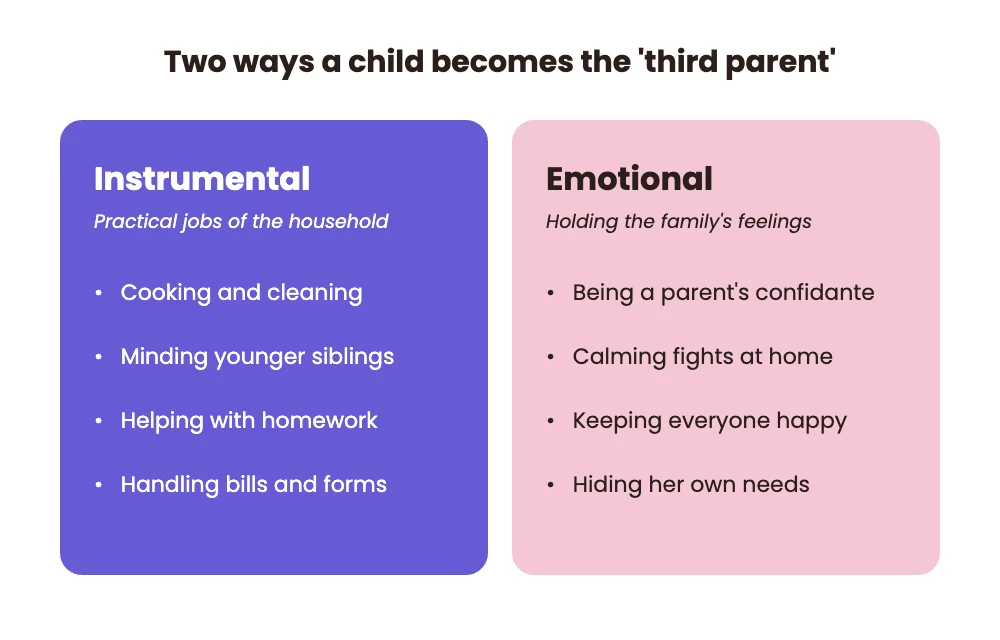
The two faces of parentification. Instrumental parentification is about tasks. Emotional parentification is about feelings, and is considered the more harmful of the two.
Source: Adapted from Jurkovic, G. J. (1997), Lost Childhoods: The Plight of the Parentified Child
Is it really about being born first?
It is tempting to blame birth order, but the evidence says otherwise. In one of the largest studies on the topic, researchers analysed data from more than 20,000 adults in Germany, the US and the UK. They found that birth order had no meaningful effect on personality traits such as conscientiousness, agreeableness or emotional stability (Rohrer, Egloff & Schmukle, 2015).
In other words, being born first does not make you responsible. Being made responsible does. What shapes the eldest daughter is the role she is handed: the expectations, the chores and the emotional work that land on her because she is the oldest, and because she is a girl.
What happens in the body and brain
There is some early evidence that this role may even leave a mark on the body. A 15-year study led by UCLA anthropologist Molly Fox followed mothers from pregnancy and then tracked their children’s development. Firstborn daughters of mothers who were highly stressed during pregnancy showed earlier signs of adrenal puberty, a stage linked to body changes and to aspects of brain maturation. This was not seen in sons, or in daughters who were not firstborn (Fox et al., 2024).
The researchers suggest that, in evolutionary terms, an older daughter who matures a little earlier may be able to help raise younger siblings when the family is under strain. It is one study and it needs to be repeated, but it fits what so many eldest daughters describe: growing up before they had a chance to be little.
Carrying responsibility that is too big for a child can also keep the stress system switched on. A brain that learns early that things fall apart unless you hold them together tends to stay on alert, scanning for problems and fixing them before anyone else notices. That vigilance is useful in a crisis. In everyday life, it can look like anxiety, exhaustion and difficulty switching off.
The eldest daughter in Indian families
In many Indian homes, the eldest daughter is given a job description long before she can read one. She is the badi beti, the one who sets an example, helps Mummy in the kitchen, keeps an eye on the younger ones and never makes a fuss. She is often praised as “so mature for her age” or “like a second mother”, words that feel like compliments but quietly tell her that her needs come second.
This sits within a wider pattern. According to India’s national Time Use Survey, women spend nearly five hours a day on unpaid domestic work, compared to just over an hour and a half for men. Girls learn early whose job the house is, and in many families, the eldest girl is first in line.
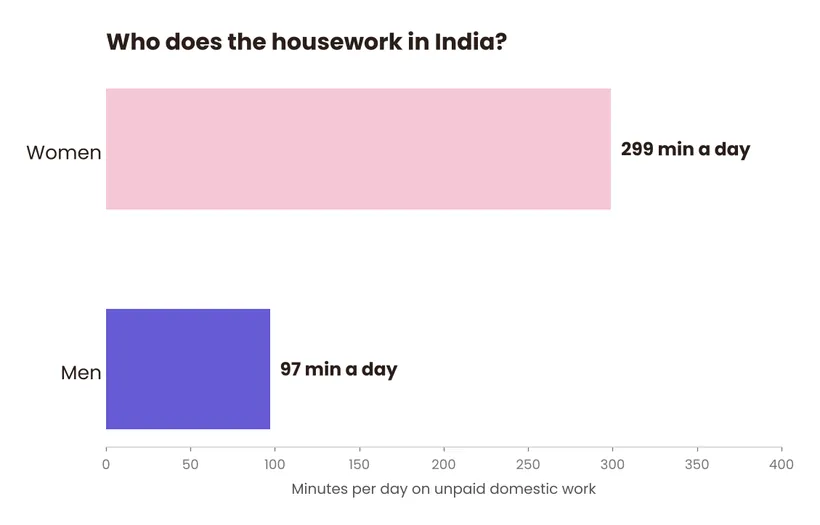
Who does the housework in India? Average minutes per day spent on unpaid domestic work by women and men who do it.
Source: National Statistical Office, Time Use in India 2019
As she grows up, the role usually grows with her. She may be the first one expected to marry, the one who helps pay for a sibling’s education, the one who explains the doctor’s advice to her parents, or the one who mediates every family argument. Even when she moves to another city or another country, she often remains the family’s emotional headquarters, taking calls at midnight and solving problems from thousands of kilometres away.
When responsibility starts to hurt
Helping your family is not harmful in itself. Many eldest daughters grow up to be capable, caring and resilient, and some forms of family responsibility can build real strengths. What matters is whether the responsibility felt fair.
A 2023 meta-analysis that combined 51 studies and more than 15,000 participants found only a weak overall link between parentification and mental health problems. The strongest link was with perceived unfairness: the sense that you gave far more than you received, and that nobody noticed (Zhang, Huang & Liu, 2023). Interestingly, the link was weaker in Eastern cultures, where helping the family is seen as normal and valued.
So the problem is rarely the chores themselves. It is being unseen. It is the eldest daughter who was never asked how she was doing, whose achievements were expected rather than celebrated, and who learned that being useful was the safest way to be loved.
In adulthood, this can show up as:
- Burnout from saying yes to everything, at home and at work
- Hyper-independence and a deep discomfort with asking for help
- Relationships where she is always the giver and rarely the receiver
- Anxiety when things feel out of her control
- Guilt when she rests, spends on herself or sets a boundary
- Repeating the pattern with her own children, or fearing that she will
Putting the weight down
Patterns learnt in childhood can be unlearnt. If you are an eldest daughter, here are a few places to start:
- Name the role. Write down the jobs you carry in your family, practical and emotional. Seeing them on paper makes it easier to decide which ones are truly yours.
- Hand one thing back. Pick one small responsibility and let someone else own it, even if they do it differently from you.
- Notice the guilt, then wait. Guilt is often a sign that you are breaking an old rule, not that you are doing something wrong.
- Grieve what you missed. It is okay to feel sad about the childhood you did not get, while still loving your family.
- Let someone take care of you. Therapy is one of the few spaces where you do not have to look after anyone else.
In therapy, we often work with the “scripts” we picked up in childhood, unspoken rules like “don’t be a burden” or “be strong”. You can read more about how these scripts form in our blog on childhood conditioning and life scripts.
Conclusion
Eldest daughters are often the glue that holds Indian families together. That strength is real, and it deserves to be recognised. But you were a child once too, and you still deserve care, rest and someone who asks how you are doing.
If this blog felt a little too familiar, our therapists understand the pressures of Indian family life from the inside. Book a free discovery call and let someone else hold things for a while.
Liked what you read?
Sign up and get the latest blog posts delivered straight to your inbox.
We respect your privacy
Related Arcticles

Domestic Violence Among Indian Families and its Impact on the Brain
In Indian families, domestic violence often hides behind cultural norms. This blog reveals shocking statistics and its impact on the brain.

Grief Explained: How our brains process loss
Discover the emotional and neurological aspects of grief, how rituals aid in healing, and why it’s okay to take your time.

Craving Connection: A Scientific Look at Why We Feel Lonely
Dive into the neuroscience of loneliness and discover why our brains crave real connection.